5 Ways Parents Can Encourage Writing at Home

One of the most powerful tools in a young writer’s life is you. Parents are more than “helpers” when it comes to writing, you’re models, motivators, sounding boards, and daily encouragers. When parents get involved in writing at home, children don’t just improve technically, they grow to love writing. 

Here are five ways you can support your child’s writing without turning your home into a grammar bootcamp.

1. Make Writing Fun and Collaborative

Writing doesn’t have to mean worksheets, edits, or red marks. 

Ideas to try:

  • Write a short story together, one parent writes a sentence, the child writes the next, and so on.
  • Keep a shared journal, each person writes a message, drawing, or memory once a week.
  • Let writing be playful, make up silly poems, write a grocery list as a “mission,” or create a comic strip with stick figures.
2. Celebrate Small Wins

Kids thrive when they feel heard and when their writing is valued. It’s not only what they write, but how they write, let their personality come through.

What you can do:

  • Ask about what they want to write, their interests, stories, or favorite characters.
  • Display their work on the fridge, on a bulletin board, in a folder.
  • Praise specific things (“I love how you described that storm,” “Your dialogue sounds like conversation”) to build confidence.
3. Create a Writing-Rich Environment

Children’s writing develops best when they regularly see and use writing in their surroundings. This means a lot of materials, regular examples, and chances to experiment.

What to include:

  • A basket or drawer with notebooks, colored pens/pencils, fun paper, sticky notes.
  • Word games around the house (labels on items, word magnets, family message board).
  • Books that include stories and examples of informal writing (cards, letters, maps, instructions).
4. Encourage Writing Across Daily Life

Writing opportunities are everywhere, especially when we don’t overthink them. If writing becomes part of daily routines, it stops feeling like a chore and starts feeling like a natural extension of imagination and communication.

Try this:

  • Let them write shopping lists, recipes, thank-you notes.
  • Encourage journaling or daily reflections, just a few lines about “What made me happy today / What was tricky” etc.
  • Write letters or emails to friends or family, even if they’re simple.
5. Provide Support Without Taking Over

Children need challenges, sometimes writing something that stretches them, and support so they don’t feel overwhelmed. Your role is to guide, encourage, and occasionally coach, without doing the work for them.

Several studies find that parental support that scaffolds writing (helping with spelling, breaking words apart, helping find letters, etc.) is meaningful especially in early stages, but importantly, letting the child have ownership builds confidence. (frontiersin.org)

How to support well:

  • Ask questions rather than issuing commands (“What do you want to say here?” rather than “Change this word.”)
  • Help break big writing tasks into smaller, manageable steps.
  • Let them revise, show how even writers revise after feedback (from parents, peers, or even self).
  • Let mistakes be part of learning, those misspellings, odd sentences, incomplete thoughts help us see how they’re thinking and growing.
How IK2W Helps

At Inspire Kids 2 Write, we work with students not just on writing skills, but on fostering their voice, confidence, and joy in writing. I believe that when children see writing as meaningful and fun, their growth explodes, both in ability and in heart.

10 Grammar Mistakes Middle Schoolers Make (and How to Fix Them)

If you’re a parent, you’ve probably seen it: your child can solve complex math problems with ease, but when it comes to writing a sentence? Suddenly, things get messy. Don’t worry – you’re not alone. Many middle schoolers (and even high schoolers!) make the same grammar mistakes. The good news? With effort and the right guidance, kids can improve quickly. At Inspire Kids 2 Write, we believe Effort = Excellence – and grammar is no exception.

Here are 10 of the most common grammar mistakes kids make – and how we help fix them:

1. Run-On Sentences

A run-on happens when two or more sentences are “squished together” without proper punctuation. It makes the writing hard to read and confusing.

Mistake: “I love my dog she is the best pet ever we play all the time.”
How to fix it, option 1 (separate into shorter sentences):
Corrected: “I love my dog. She is the best pet ever. We play all the time.”

How to fix it, option 2 (combine with a joining word):
Corrected: “I love my dog, and she is the best pet ever. We play all the time.”

2. Sentence Fragments

A fragment looks like a sentence but isn’t complete – it doesn’t express a full idea.

Mistake: “Because I went to the park.” (incomplete thought)
How to fix it: Add missing information so it can stand on its own.
Corrected: “I was happy because I went to the park.”

3. Misusing Commas

Without commas, sentences can feel rushed or unclear. Commas show natural pauses.

Mistake: “After dinner we watched a movie.”
How to fix it: Teach kids to add commas after introductory phrases or in lists.
Corrected: “After dinner, we watched a movie.”

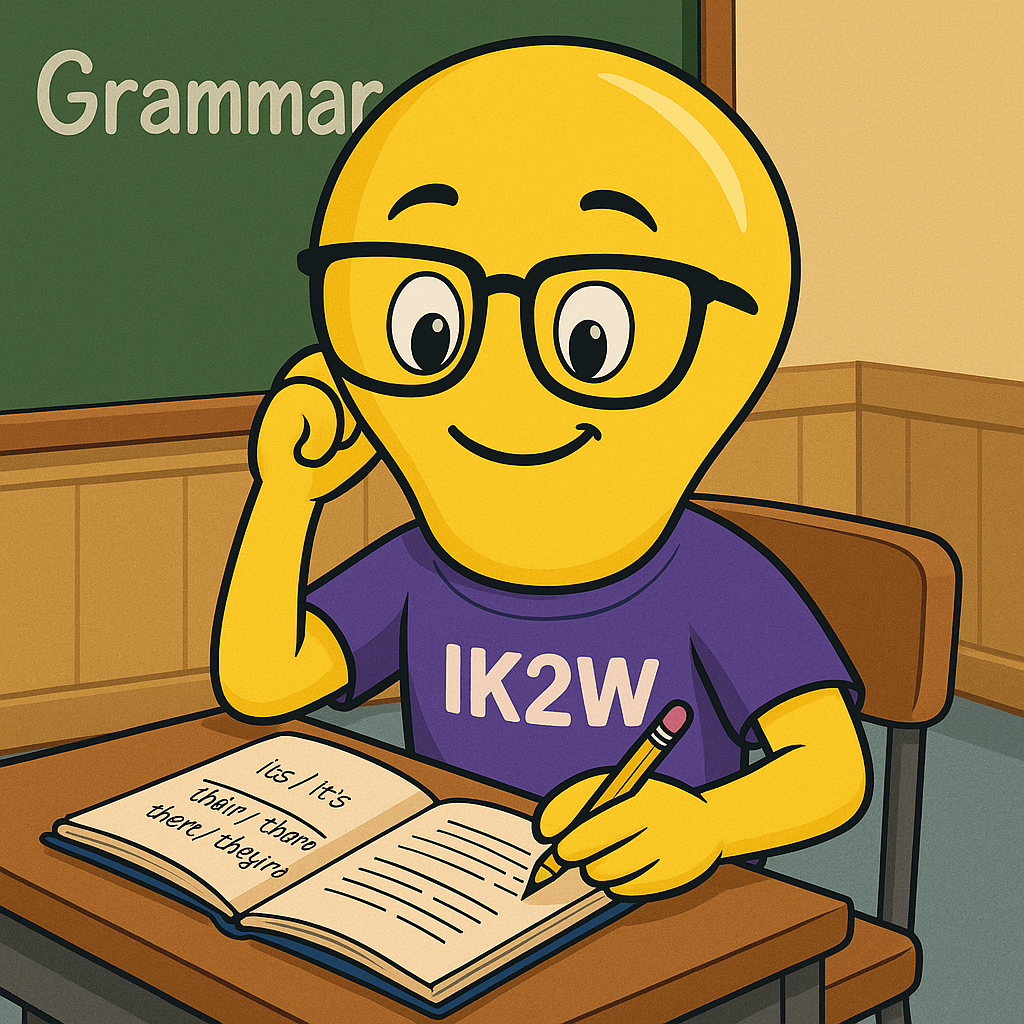
4. Confusing Their / There / They’re

These words sound the same, but they mean different things. Mixing them up makes writing look sloppy.

Their → shows ownership (“Their house”)
There → shows location (“Over there”)
They’re → means “they are” (“They’re going”)

Mistake: “There going to the store.”
How to fix it: Practice with memory tricks.

5. Mixing Up Verb Tenses

Verbs show time. If the verb doesn’t match the time, the sentence sounds wrong.

Mistake: “Yesterday, I go to the park.”
How to fix it: Match the verb with when the action happened.
Corrected: “Yesterday, I went to the park.”

6. Apostrophe Trouble

Apostrophes can show ownership (the cat’s toy) or make contractions (don’t = do not). Without them, meaning gets confusing.

Mistake: “The cats toy is missing.”
How to fix it: Teach kids when to add the apostrophe.
Corrected: “The cat’s toy is missing.”

7. Overusing “And”

Overusing “and” makes writing sound childish and repetitive.

Mistake: “I went to the store and I bought chips and I bought juice and I saw my friend.”
How to fix it:  Combine ideas with commas or break into shorter sentences.
Corrected: “I went to the store, bought chips and juice, and saw my friend.”

8. Subject-Verb Agreement

The subject (who/what the sentence is about) must “agree” with the verb. Otherwise, it sounds off.

Mistake: “The dogs runs fast.”
How to fix it:  Make sure single subjects take singular verbs and plural subjects take plural verbs.
Corrected: “The dogs run fast.”

9. Confusing Its / It’s

This is one of the trickiest! Its (no apostrophe) shows ownership (“The dog wagged its tail”).
It’s (with apostrophe) means “it is” (“It’s a sunny day”). Mixing them up changes the meaning of the sentence.

Mistake: “Its a sunny day.”
How to fix it: Teach the memory trick: It’s always = it is.

10. Forgetting Capital Letters

Capital letters show importance – names, places, days of the week, and the start of sentences. Without them, writing looks careless.

Mistake: “on monday, we went to disneyland.”
How to fix it: Teach kids to edit by scanning for capitals.
Corrected: “On Monday, we went to Disneyland.”

Why This Matters

You may be thinking: These are small mistakes. Do they really matter? Yes! Grammar is like math – it gives structure and rules, so kids can communicate clearly. A child who writes strong, clean sentences not only does better on school assignments, but also feels more confident expressing themselves.

And just like in math, it’s not about being “gifted.” It’s about effort, practice, and having the right support. That’s why we remind our students: Effort = Excellence.

Final Word for Parents

If you’ve been worried about your child’s grammar, know this: mistakes are normal. With practice and patience, kids do get better. And once grammar feels easier, writing becomes less stressful – and sometimes even fun.

Fall classes at Inspire Kids 2 Write are underway. Let us know if we can help your child learn to write with confidence.

Contact us at  inspirekids2write.com.

Why Writing Still Matters in the Age of AI

A parent asked me recently: “With AI getting so advanced, why should my child still learn how to write? Won’t those skills become pointless?”

It’s such a thoughtful question – and one I love answering. The truth is, writing isn’t disappearing. In fact, it’s becoming more valuable than ever. Here’s why:

Writing Is Thinking

Writing isn’t just about putting words on paper – it’s about organizing our ideas, making connections, and discovering what we really believe. When students write, they are actually learning how to think clearly. That’s a skill no machine can replace.

AI Is a Tool, Not a Replacement

AI can generate text, but it can’t decide if that text is meaningful, persuasive, or accurate. Students who know how to write will use AI as a powerful amplifier, while those without strong writing skills risk blindly accepting whatever the machine spits out.

Creativity and Voice Still Belong to Us

Every child has a unique way of seeing the world. Their humor, experiences, and perspective cannot be replicated by a program. Authenticity matters, and strong writing ensures their voice shines through – even in an AI-driven world.

Writing Builds Lifelong Skills

The ability to explain, persuade, and inspire is needed in every career. From pitching ideas to leading teams, students who can write well will always stand out. Writing builds confidence, critical thinking, and communication – skills that last a lifetime.

AI Makes Human Writing More Valuable

As AI fills the world with average writing, the standout pieces will be those that feel truly human – nuanced, creative, and personal. Students who master writing will rise above the noise.

The bottom line: Writing isn’t being replaced by AI – it’s being elevated. In the hands of a strong writer, AI is just another tool. But without the foundation of writing, students can’t harness its full potential. That’s why we teach not just skills, but passion – because when skill meets passion, students don’t just keep up with the future…they lead it.

Ready to Inspire Your Child’s Writing?

At Inspire Kids 2 Write, we believe every student has a voice worth developing. Our online writing program helps students build strong skills, creative confidence, and a lifelong love of writing.

Registration is open now! Visit inspirekids2write.com or email me at writingclass2005@gmail.com to learn more and secure your child’s spot.

Why Strong Writing Skills Help Kids Shine in School (and Beyond)

If you’ve ever watched your child struggle to get words down on paper, you know how frustrating writing can feel. The good news? Writing is not just about grammar rules and essays. When kids learn to write with confidence, it changes everything—from their schoolwork to how they see themselves.

At Inspire Kids 2 Write, we believe writing is more than an academic skill. It’s a tool for thinking, a way to communicate clearly, and more importantly, it’s a path to finding your voice.

Writing Builds Confidence

Here’s something important: when kids feel good about their writing, they start to feel better about school in general. Research even shows that confident writers are less anxious, more motivated, and more successful in the classroom. That’s because writing gives them a sense of control—they can take messy ideas and turn them into something strong and clear.

Writing is a Life Skill

Strong writing doesn’t just help with English homework. It teaches kids to organize thoughts, solve problems, and explain ideas—skills that matter in every subject. Math, science, history… it all gets easier when students know how to put their thinking into words.

Writing Opens Doors

One of the biggest stress points for families is college. Here’s the truth: college admissions officers care about writing. A well-written essay can make a huge difference. But here’s the good news—kids don’t suddenly “get good” at writing their senior year. Confidence and skill build over time. Starting now means your child will be ready when it matters most.

How Inspire Kids Helps

In our classes, we focus on both sides of writing:

  • The nuts and bolts—grammar, sentence structure, vocabulary.
  • The fun side—projects that spark creativity, like designing a travel brochure or writing a survival guide.

This mix is what makes kids go from “I can’t do this” to “I actually like this!”

Ready to See the Change?

Fall classes start September 8th, and spots are filling quickly. Some levels already have waitlists. Don’t wait—let’s help your child build skills, confidence, and maybe even a love for writing.

Contact us today! http://www.inspirekids2write.com