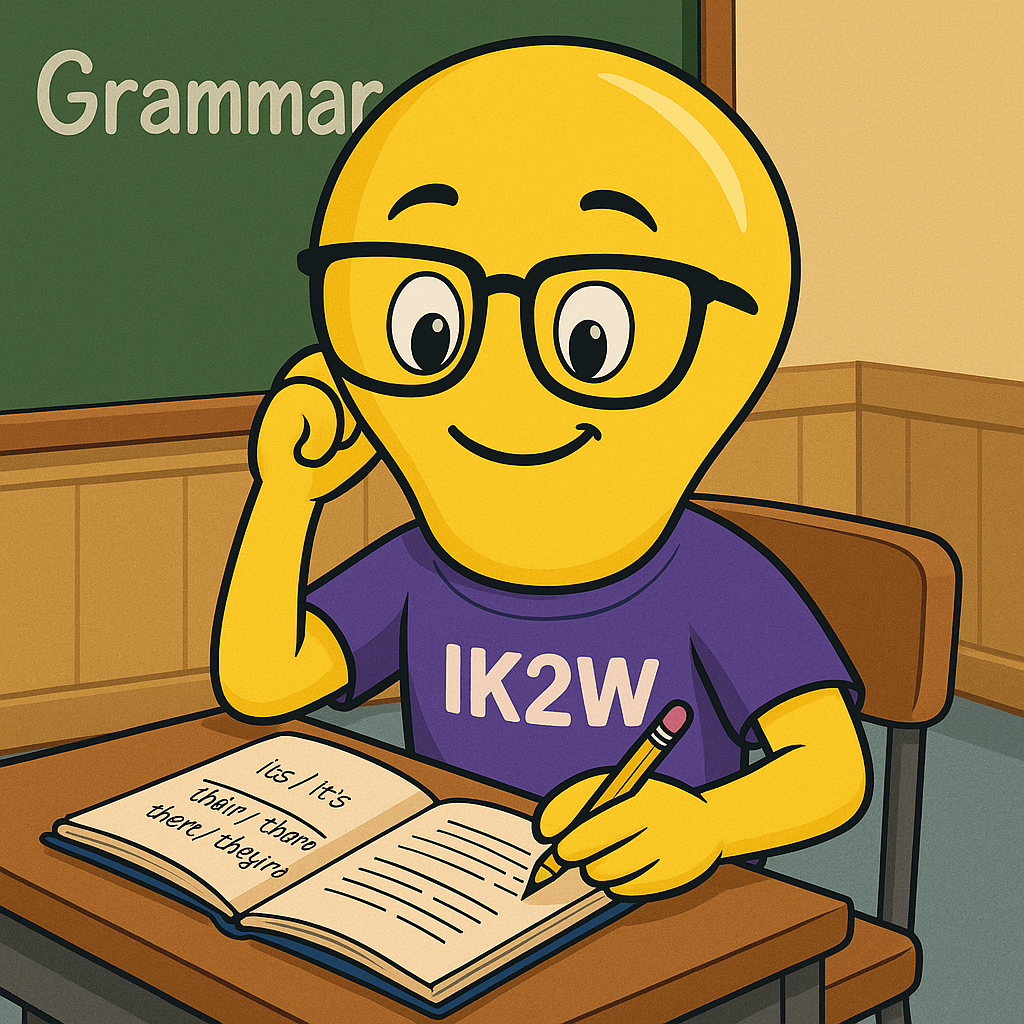
If you’re a parent, you’ve probably seen it: your child can solve complex math problems with ease, but when it comes to writing a sentence? Suddenly, things get messy. Don’t worry – you’re not alone. Many middle schoolers (and even high schoolers!) make the same grammar mistakes. The good news? With effort and the right guidance, kids can improve quickly. At Inspire Kids 2 Write, we believe Effort = Excellence – and grammar is no exception.
Here are 10 of the most common grammar mistakes kids make – and how we help fix them:
1. Run-On Sentences
A run-on happens when two or more sentences are “squished together” without proper punctuation. It makes the writing hard to read and confusing.
Mistake: “I love my dog she is the best pet ever we play all the time.”
How to fix it, option 1 (separate into shorter sentences):
Corrected: “I love my dog. She is the best pet ever. We play all the time.”
How to fix it, option 2 (combine with a joining word):
Corrected: “I love my dog, and she is the best pet ever. We play all the time.”
2. Sentence Fragments
A fragment looks like a sentence but isn’t complete – it doesn’t express a full idea.
Mistake: “Because I went to the park.” (incomplete thought)
How to fix it: Add missing information so it can stand on its own.
Corrected: “I was happy because I went to the park.”
3. Misusing Commas
Without commas, sentences can feel rushed or unclear. Commas show natural pauses.
Mistake: “After dinner we watched a movie.”
How to fix it: Teach kids to add commas after introductory phrases or in lists.
Corrected: “After dinner, we watched a movie.”
4. Confusing Their / There / They’re
These words sound the same, but they mean different things. Mixing them up makes writing look sloppy.
Their → shows ownership (“Their house”)
There → shows location (“Over there”)
They’re → means “they are” (“They’re going”)
Mistake: “There going to the store.”
How to fix it: Practice with memory tricks.
5. Mixing Up Verb Tenses
Verbs show time. If the verb doesn’t match the time, the sentence sounds wrong.
Mistake: “Yesterday, I go to the park.”
How to fix it: Match the verb with when the action happened.
Corrected: “Yesterday, I went to the park.”
6. Apostrophe Trouble
Apostrophes can show ownership (the cat’s toy) or make contractions (don’t = do not). Without them, meaning gets confusing.
Mistake: “The cats toy is missing.”
How to fix it: Teach kids when to add the apostrophe.
Corrected: “The cat’s toy is missing.”
7. Overusing “And”
Overusing “and” makes writing sound childish and repetitive.
Mistake: “I went to the store and I bought chips and I bought juice and I saw my friend.”
How to fix it: Combine ideas with commas or break into shorter sentences.
Corrected: “I went to the store, bought chips and juice, and saw my friend.”
8. Subject-Verb Agreement
The subject (who/what the sentence is about) must “agree” with the verb. Otherwise, it sounds off.
Mistake: “The dogs runs fast.”
How to fix it: Make sure single subjects take singular verbs and plural subjects take plural verbs.
Corrected: “The dogs run fast.”
9. Confusing Its / It’s
This is one of the trickiest! Its (no apostrophe) shows ownership (“The dog wagged its tail”).
It’s (with apostrophe) means “it is” (“It’s a sunny day”). Mixing them up changes the meaning of the sentence.
Mistake: “Its a sunny day.”
How to fix it: Teach the memory trick: It’s always = it is.
10. Forgetting Capital Letters
Capital letters show importance – names, places, days of the week, and the start of sentences. Without them, writing looks careless.
Mistake: “on monday, we went to disneyland.”
How to fix it: Teach kids to edit by scanning for capitals.
Corrected: “On Monday, we went to Disneyland.”
Why This Matters
You may be thinking: These are small mistakes. Do they really matter? Yes! Grammar is like math – it gives structure and rules, so kids can communicate clearly. A child who writes strong, clean sentences not only does better on school assignments, but also feels more confident expressing themselves.
And just like in math, it’s not about being “gifted.” It’s about effort, practice, and having the right support. That’s why we remind our students: Effort = Excellence.
Final Word for Parents
If you’ve been worried about your child’s grammar, know this: mistakes are normal. With practice and patience, kids do get better. And once grammar feels easier, writing becomes less stressful – and sometimes even fun.
Fall classes at Inspire Kids 2 Write are underway. Let us know if we can help your child learn to write with confidence.
Contact us at inspirekids2write.com.
 Inspire Kids 2 Write